Showing posts with label Covid 19. Show all posts

Tuesday, September 1, 2020

Facing the Next Wave of Covid Family Life


When Covid hit, and children came home for remote learning, we all found our inner hero and rose to the occasion.  We looked for the good in the situation, joked about working in pajamas, and turned a room in our house into a family work center. Psychologist Ann Masten says we went to our surge capacity to survive a new crisis.  A surge capacity is a collection of skills (emotional, mental, and physical) that come over us in a wavelike sweep allowing us to cope. Our surge capacity helps us use our inner resilience. In this state, we get creative about problem-solving; we activate our ability to find gratitude and the strength to ignore difficulty. God gave us this capacity to get us through a difficult time.

Our challenge now is that the difficult time has become a chronic situation. Add to that the summer is over, and we have new burdens. We have depleted our surge capacity, and the road ahead looks daunting.

We are tired. We are tired of adjusting, tired of creative problem-solving, tired of new covid news – even good news. When we feel depleted, this adds a whole new level of anxiety to our thinking. We ask ourselves, "How are we going to manage?" and for the first time, we have no idea.

The Lord is near to the brokenhearted and saves the crushed in spirit. Psalm 34:18

After the reminder of God's grace, I note in this verse that I am not the only one to feel depleted. The psalm writer gets what we are going through, and God tells us He has a plan to address our needs. I urge you to read the entire psalm and notice how the emotions gravitate from one extreme to the other: crying to gratitude, hunger to blessing, affliction to delivery, and peace. Covid might be a new virus, but what we are going through is not new.

What are the tools God gives us to repair our crushed spirit? How do we replenish our surge capacity?

Forgive: Admit that you are not a superhero and accept God's forgiveness for your mistakes. Teach your family to be easier in forgiving each other. Challenging times demand we develop our grace muscles.

Grieve: As a family, list the activities and routines you miss. Write or draw about the things you discuss and put them in a box with the assurance that you will retrieve them. Save the box as a covid time capsule and remind yourselves the box will be opened some day.

Breathe: While taking time to practice deep breathing will help replenish our surge capacity, it is equally healthy to do to your breathing outside in the sunshine. Playing outside will reinforce the idea that there are still good things to be experienced. When we are outside, we relieve anxiety and revitalize the parts of our brain that help us to focus.

Create: At this point, it is hard to imagine we will ever forget this year, but so much of what we are learning will be lost as we work to survive. Take time to document your family's life in photos, stories, songs, and favorite survival Bible verses. This activity will replenish your surge capacity for the short term and provide you with memories to give you courage in the long term.

Help: Look for ways to help others because, in addition to the apparent benefit, it also restores a sense of control and reduces anxiety. Helping others is an excellent coping strategy to teach your children.

Study: It is always a challenge to find time to study God's word as a family. I recommend diving into the Psalms. Highlight a verse or two and talk about how it applies to your family.

Oddly, the best thing you and your family can say is, "We can't take it anymore!"

At this point, the point of giving up control is when we can trust in our loving Father.

Fear not, for I am with you; be not dismayed, for I am your God; I will strengthen you, I will help you,
I will uphold you with my righteous right hand. Isaiah 41:10


Weary Joy: The Caregiver's Journey

Concordia Publishing House

Amazon

Kindle

Friday, May 22, 2020

Grieving the Semester That Wasn’t


If your children do not seem to “be themselves” lately, it is wise to consider they might be grieving.

You would think that because God gave us separate emotions to use on different occasions that the brain would be able to choose the right emotion for the job.

We might think that – but we would be wrong.

My theory may not be official, but I imagine the brain keeps emotion in a sack, and sometimes when it doesn’t know which emotion is correct, it picks a random one and applies it. This phenomenon is especially real for children who are beginners in the business of feelings. Grief may not always look like grief.

For parents, it is a good idea to frequently make a check on the emotional expressions of your children to see if there is a hidden emotion.  For instance, the school year has ended. While this means family members no longer have to fight for computer time, and parents no longer need to worry over lessons, it still does not feel like summer vacation.

This year did not have the usual routine that helps school-aged children to bring closure to the year. Your child may not have mentioned missed field trips, yearbook signings, or special events that typically replace the grief of change with good memories. And your child does not need to be graduating to feel grief over what was lost. The brain knows that some part of the end-of-year routine is missing, creating sadness and anxiety. The brain does not ignore grief, and it doesn't always understand what to do with it.

Grief is a reasonably unfamiliar emotion for many children. If they have not experienced the loss of a family member or a pet, they might not recognize grief over losing end-of-year activities. And while this kind of grief is not as intense as a family loss, it is there none-the-less.

Because your child may not recognize this loss, this may impact behavior in much the same way as anxiety. In other words, it may not look like grief.

Here are three things that you can do with your child if you suspect that grief is lurking behind unexpected or hard-to-change behavior.

Sit in grace. While the impulse may be to immediately correct the behavior, this is a perfect opportunity to spend some time in grace mode. Some small things ask for empathy and reframing.

“I wonder if you are feeling sad about missing the end of the school year? I think your teacher and your classmates feel the same way. What can you do to help yourself feel better?

Do you see what we did there? This response correctly identifies the feelings of grief and points the child in the right direction for regulating -- or dealing with -- those feelings.

Wait a bit. Some behaviors cannot you cannot ignore, but most can wait until after a cooling-off period. Allow your child some time to calm down and find his or her sadness. Talk with your child about grief before applying a consequence. Often, once children realize the emotion that caused the behavior, they no longer wish to repeat the behavior. If it is a persistent behavior, understanding the "why" behind it will help your child find a better way to express feelings.

Make connections: When children experience a new emotion, they lack an understanding of how to regulate it. Even if your child denies that he or she is sad about the end of the year, it doesn’t hurt to make that connection so they can gradually learn how to identify emotions and how to use them more effectively. Identify grief as the reason for the behavior. Say it aloud and allow your child to talk about it and about what can be done.

It is a healthy product of grief to do something to remember what was lost, such as communicate with a friend or write a letter to the teacher.  An effective way to explain this is to point out the difference between dealing with sadness and anger and doing things that make others sad or angry. 

We want our children to learn they can control their behavior in nearly any emotional state. Once they can do this, their emotions begin to help them understand what has happened instead of possibly working  against their better interests.

The LORD is near the brokenhearted and saves the crushed in spirit. Psalm 34:18

God in His providence gave us emotions to help us learn, to help us make decisions, and to help us live and work with each other. Emotions also help us to comprehend new experiences, overwhelming experiences, and unwelcome ones. It is a gift to be able to help your children to understand and use emotions. It is a task with which God will gladly help. He cares about your emotions, too.

Family Faith Sharing Activity: Puzzles

https://www.youtube.com/watch?v=ypE083mMktM

Tangrams are fun puzzles for the family. Some are easy, some are challenging, and sometimes the youngest member of the family does the best work because he or she can think outside the square box. Practicing these puzzles not only creates family time, but it supports mathematical thinking, as well.

Puzzles are more manageable when we know the final result. Tangrams can remind us that God is bigger than the puzzles in our world. God understands the coronavirus and mask-wearing and what is safe. God also knows when this chapter in our lives will end. He is the maker of the puzzle, and He loves and protects us.

Cast all your anxiety on him because he cares for you. I Peter 5:7

This verse is from the readings for this Sunday and is a favorite verse for many. It is a blessing to be able to give our worries, frustrations, and confusion over to Jesus and to rest, knowing that He cares for us in ways we cannot imagine. 

Working with your children on any puzzle – or at any other activity – allows you to remind them of God’s love and protection. Whether it is anger, fear, worry, joy, or surprise, we feel the emotions God gives us. Throughout it all, it is best to trust and thank Him.


Saturday, May 2, 2020

Family Faith Sharing Activity May 3: Brain Game-Changer

https://www.youtube.com/watch?v=1EEkGJWGeWw


If you are old enough, you may recognize the origami fortuneteller in this picture. It is simple to make and fun to play with, but in this message, we are not going to use it to tell our fortune. Instead we will use it to choose an activity that helps us to move from our hot brains (fear, anger, worry) to our cool brains (helping others, problem-solving, learning).

The LORD is my shepherd; I shall not want. Psalm 23:1

Psalm 23 is a beautiful prayer that reminds us of how God cares for us and protects us. When we are in a state of “I shall not want,” we are content with the knowledge that we are God’s sheep. When anxiety builds up and causes us to be angry, tired, and confused, we can take a brain game-changer break and get back to a place of contentment and peace.


As part of this family message, I am challenging families to set about memorizing Psalm 23. It may seem daunting, but it is quite doable for most school-age children. The link above provides tips for learning the verses in fun effective ways. For each verse, I have included some devotional thoughts, discussion questions, and a prayer. Every moment we spend in scripture is time well spent as God uses this to increase our faith. Memorization is a fun challenge, but it is not necessary.

I pray God’s blessings for families during this time of upheaval. Times like these are when we depend on our families most dearly. God is using these days to help you and your children to grow in many positive ways. And yes, even on days when it doesn’t feel like it.

Thursday, April 23, 2020

Family Faith Sharing Activity - Unconditional Love

https://www.youtube.com/watch?v=EjxQDJdRaC8


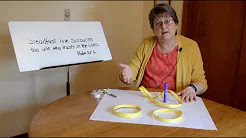
The Road to Emmaus may not seem like a strange story to share with young children, but it provides us with an opportunity to talk about how Jesus is with us even when we don’t recognize He is there.

Using paper, scissors, tape, and a marker, children can make and experiment with an ordinary paper circle and a one-sided Moebius strip. One paper loop can be cut into two, and the other remains undivided even after cut.

Connecting this to the bible verse about being surrounded by steadfast love, we remind children that the love of God is unconditional.

He loves us when we do good things.

He loves us when we do wrong things.

He loves us when everything is going well, and we are happy.

He loves us when we are sad or lonely or angry about what we must do to be safe.

God’s love surrounds us even when we don’t realize or recognize it.

Spend some time talking with your children about how our current situation makes you feel and makes them feel. Learn the Bible verse together and remind each other of God’s unconditional, steadfast love.

Steadfast love surrounds the one who trusts in the LORD. Psalm 32:10